

What are Work Incentives?
Work Incentives are special rules created by the Social Security Administration (SSA) that make it easier and safer for people with disabilities to try working without immediately losing their cash benefits or healthcare coverage.
Many individuals worry that earning a paycheck means falling off a "benefits cliff." Work Incentives function as a safety net: they allow someone to test their ability to work, keep more of their earnings, deduct out-of-pocket disability expenses, and retain Medicare or Medicaid while they transition toward greater financial independence.
How They Work (By Benefit Type)
Because Supplemental Security Income (SSI) and Social Security Disability Insurance (SSDI) operate differently, their Work Incentives target different rules.
1. For Social Security Disability Insurance (SSDI)
SSDI work incentives provide a structured timeline to test employment while keeping full cash benefits and Medicare:
Trial Work Period (TWP): Allows a beneficiary to test their ability to work for at least 9 months (within a rolling 60-month window) while receiving their full SSDI check, regardless of how much they earn.
Extended Period of Eligibility (EPE): A 36-month window following the Trial Work Period. During these 3 years, the person receives their SSDI payment for any month their earnings fall below the SSA work threshold (Substantial Gainful Activity, or SGA), without needing to reapply.
Continuation of Medicare: Keeps premium-free Medicare Part A coverage active for at least 93 months (over 7.5 years) after the Trial Work Period begins, even if cash benefits pause due to earnings
2. For Supplemental Security Income (SSI)
SSI is needs-based, so work incentives focus on how earnings are counted and keeping Medicaid:
General and Earned Income Exclusions: Social Security does not count the first $20 of any monthly income, plus the first $65 of earned wages, and then only counts half of the remaining gross pay. This ensures an individual always ends up with more total monthly money when working than from SSI alone.
Section 1619(b) (Medicaid While Working): Allows a person to keep their Medicaid coverage even if their earnings become high enough to reduce their monthly SSI check to $0, up to a state-specific income threshold.
Student Earned Income Exclusion (SEIE): Allows qualifying students under age 22 who attend school regularly to exclude a substantial amount of monthly and annual earnings before calculating their SSI payment.
3. Rules That Help Both SSI and SSDI
Impairment-Related Work Expenses (IRWE): If a person pays out of pocket for items or services they need in order to work because of their disability (such as specialized transportation, copays for essential maintenance medications, or adaptive equipment), SSA can deduct those costs from countable earnings.
Expedited Reinstatement (EXR): If benefits stop because of earnings, but the person later has to stop working or reduce hours within 5 years due to their disability, benefits can be restarted quickly with up to 6 months of temporary cash payments while SSA reviews the case, bypassing a brand-new application.
Subsidies and Special Conditions: SSA accounts for extra support provided on the job (such as additional supervision, extra breaks, or assistance from coworkers) by deducting the value of that support from gross earnings when evaluating work activity
How Someone Accesses Work Incentives
Free Benefits Counseling (WIPA): Individuals receiving SSI or SSDI can work with a certified Community Work Incentives Coordinator (CWIC) through a Work Incentives Planning and Assistance (WIPA) project at no cost. A CWIC drafts an individualized Benefits Summary and Analysis (BS&A) mapping out exactly how wages will interact with benefits.
Vocational Rehabilitation Counselors: Agencies like Michigan Rehabilitation Services (MRS) frequently coordinate with certified work incentive practitioners or WIPA programs to integrate benefits planning into an Individualized Plan for Employment (IPE).
Self-Reporting to SSA: Beneficiaries claim incentives by reporting wages monthly and submitting appropriate documentation (such as receipts for IRWEs or employer subsidy questionnaires) directly to their local Social Security office.
What is Michigan Rehabilitation Services?
Since Menace Acre Farm is in Michigan, I’m most familiar with Michigan Rehabilitation Services as a vocational rehabilitation agency, but I am able to work with clients in any state (though I may need to learn your state’s policies as I go if I am not familiar with them already by the time you reach out. So what is Michigan Rehabilitation Services?
Michigan Rehabilitation Services (MRS) is a state agency designed to help people who have a physical, learning, mental health, or emotional disability find, keep, or grow in a job.
In short: if a disability makes it hard to work, MRS pairs individuals with a vocational counselor to figure out goals and provide the tools needed to succeed. This can include career counseling, job training, resume and interview help, assistive technology or equipment, and support with job placement.
Who Qualifies
Generally, a person is eligible if:
They have a documented physical or mental impairment.
That condition creates a barrier to finding or keeping employment.
They require vocational rehabilitation services to prepare for, get, or keep a job.
(People receiving SSI or SSDI based on disability are presumed eligible).
How to Apply
Applying can be done in a few straightforward ways:
Online: Fill out the direct application portal on the State of Michigan website at app.leo.state.mi.us/mrs/apply.
By Phone: Call toll-free at 1-800-605-6722 to request an application or locate the nearest branch.
In Person or Local Contact: Visit or call a local county MRS office (frequently co-located with or connected to Michigan Works! service centers) to pick up a paper packet or schedule an orientation.
What Happens Next
Application & Intake: After the form is submitted, a counselor schedules an intake meeting to discuss work background, interests, and how the condition affects daily tasks and employment.
Eligibility Review: MRS reviews existing medical, psychological, or school records (such as IEPs/504 plans). If needed records are unavailable, MRS can coordinate assessments at no cost. Eligibility is typically decided within 60 days.
Building the Plan: Once approved, the individual and their counselor draft an Individualized Plan for Employment (IPE) outlining specific career goals and the exact supports MRS will fund or provide to reach them.
Can’t I just have you help me?
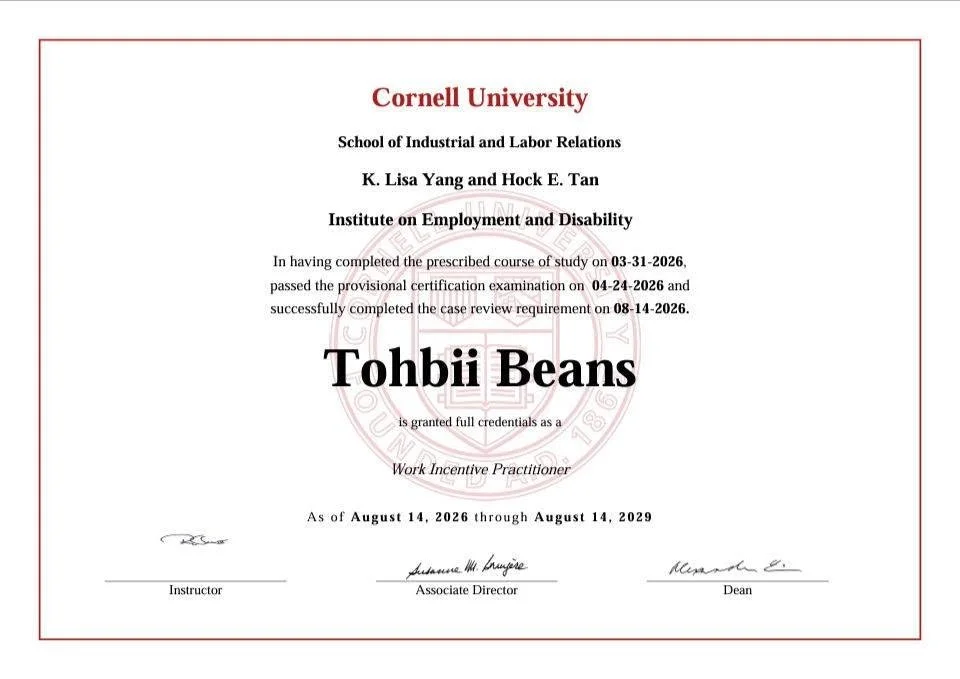
Why yes, yes you can. I just so happen to be certified AND certifiable. Below is my certification and some more helpful information.
How to Work With Me Through Michigan Rehabilitation Services (MRS)
If you receive SSI or SSDI and worry about losing your benefits or healthcare by going to work, Benefits Counseling can help. As a certified Work Incentive Practitioner (WIP), I help you understand work rules, use work incentives to protect your monthly income, and keep your Medicaid or Medicare coverage safe while you pursue your career goals.
If you are an MRS customer, MRS can fully fund your Benefits Counseling sessions at no cost to you.
Step-by-Step: How to Request Me as Your Provider
Under MRS rules, you have the right to choose who provides your authorized services. Here is how to get started:
Contact Your MRS Counselor: Send an email or call your assigned Michigan Rehabilitation Services counselor.
Request Benefits Counseling: Let them know you want Benefits Counseling added to your Individualized Plan for Employment (IPE).
Share My Provider Information: Give your counselor the details below so they can issue the formal Authorization for Purchase:
Provider Name: Tohbii C Beans
Service: Fee-for-Service Benefits Counseling (Work Incentive Practitioner)
SIGMA Vendor Code: VS0379073
Phone: (616) 551-9424
Here’s an Example of What You Can Write to Your Counselor.
"Hello, [Counselor's Name],
I would like to add Benefits Counseling to my Individualized Plan for Employment to help me understand how working will affect my disability benefits and healthcare.
Under informed choice, I would like to work with Tohbii C Beans (SIGMA Vendor Code: VS0379073). Could you please issue that Authorization so we can begin?"
Once your counselor approves the service and sends over an authorization, we can schedule your initial intake and begin building your personalized benefits plan!